Time registration in hospitality
For part of your team, registration is already mandatory today: flexi-jobbers must be registered in a way the NSSO accepts, and for part-timers you record every deviation from the schedule. A general obligation for all employees has been announced, but on 22/09/2026 it has not been voted or published. Below: a working day with a split shift, a forgotten clock-out and which rule applies to what.
Written by Robin Verbelen, founder of Klox
Updated on 22/09/2026Last checked on 22/09/2026
A Friday in a brasserie, registered
Brasserie De Kaai in Ghent is a fictitious business with six people. On Friday 18/09/2026, kitchen and floor staff work a split shift, from 11:00 to 14:30 and from 17:30 to 22:30. The kitchen assistant works straight through, with a half-hour break. This is how that day appears in the register:
| Employee | Schedule | Registered | Worked |
|---|---|---|---|
| Jonas, cook (full-time) | 11:00-14:30 and 17:30-22:30 | 11:01-14:34 and 17:30-22:29 | 8h32 |
| Elif, floor (full-time) | 11:00-14:30 and 17:30-22:30 | 11:02-14:33 and 17:31-22:45 (after correction) | 8h45 |
| Mehdi, kitchen assistant (full-time) | 10:00-18:30, 30 min break | 09:58-18:31, break 14:02-14:32 | 8h03 |
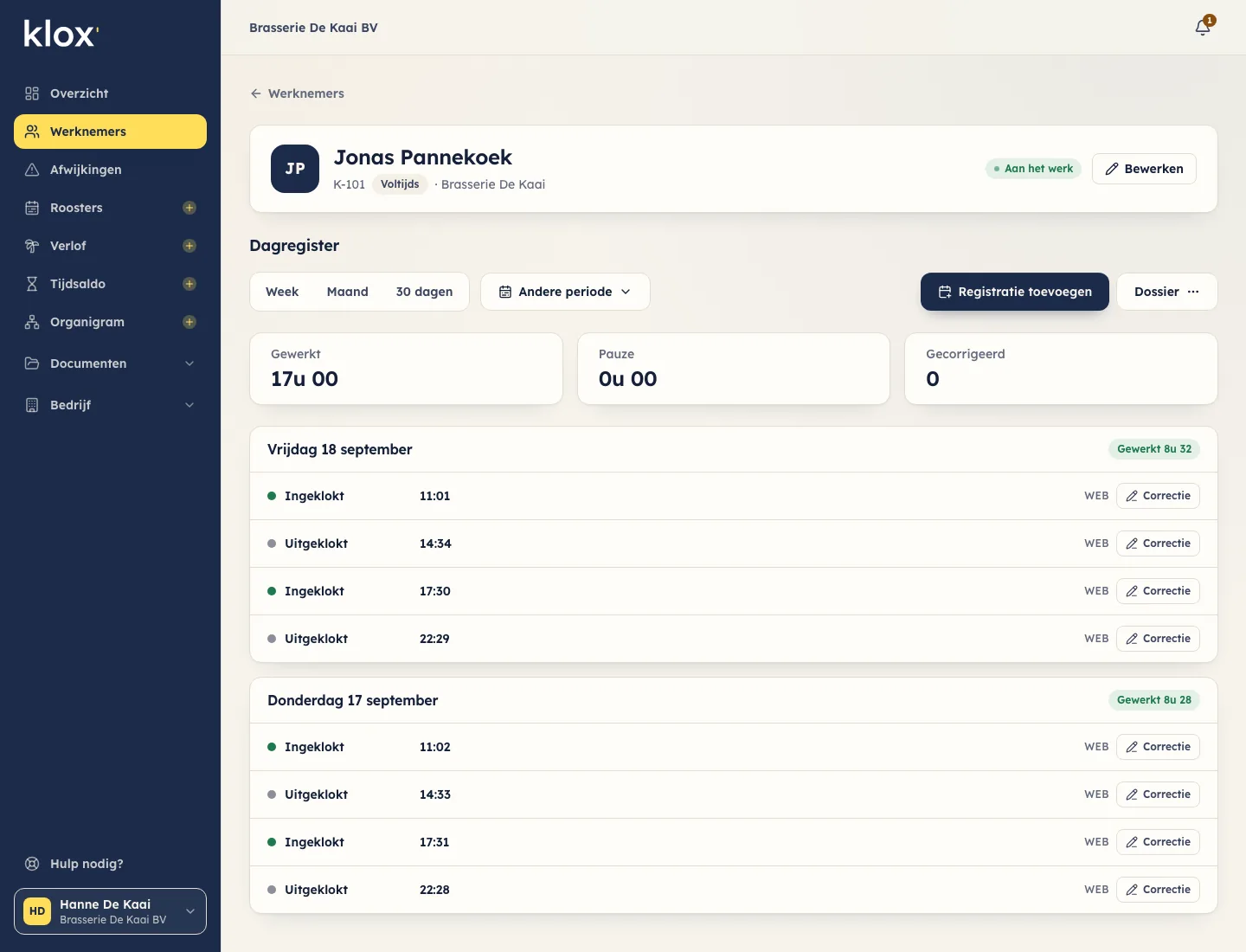
Every interruption is a separate clock-out and a new clock-in. The register counts the minutes between in and out, not the schedule: whoever clocks out at 14:34 worked until 14:34. The difference from the schedule is visible without anyone noting it separately.
Forgot to clock out: what stays in the register
Elif clocks in on Friday at 17:31 for the evening shift and forgets to clock out at 22:45. Such a shift cannot stay open, and it cannot be changed silently either. In Klox it works like this:
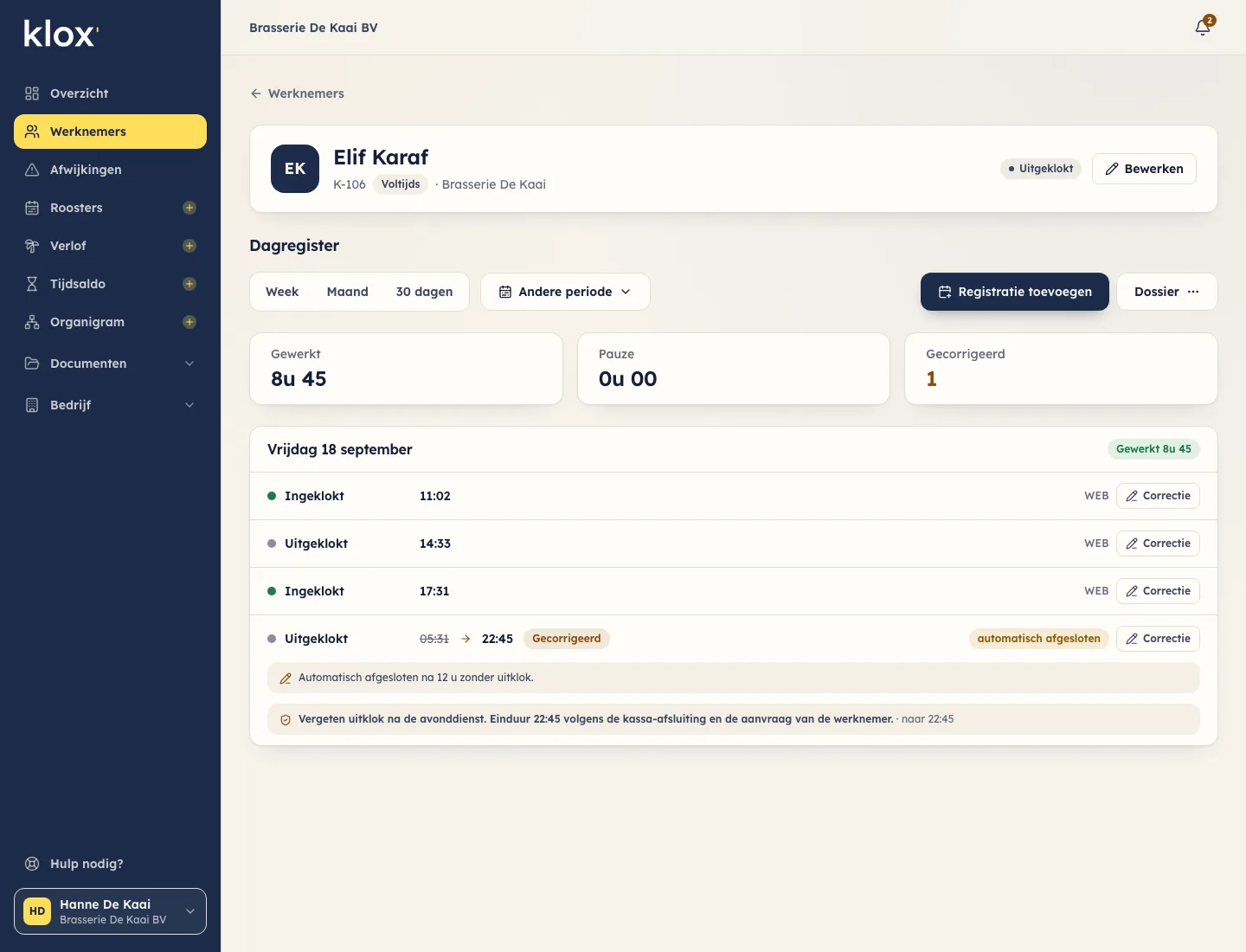
1. Closed automatically, as a separate entry
After 12 hours without a clock-out, on Saturday 19/09 at 05:31, Klox closes the shift with an entry of its own, marked as closed automatically. The 12 hours are the default and can be set per company. The shift shows up in the owner's deviations.2. The employee requests a correction
Elif sees the automatic closure in her own register and requests a correction: she forgot to clock out and stopped at 22:45.3. The owner corrects, with a reason
The owner checks the end time against the till closing and registers a correction to 22:45, with the reason. The 05:31 clock-out is not deleted: it stays visible, struck through, next to the new time, with who corrected it and when.
Flexi-jobbers
For flexi-jobbers, registration depends on the contract. With an oral flexi contract, you file a daily Dimona stating the start and end time of the task.[1] With a written contract, you file a Dimona for a period of at most one quarter, and you must also register attendance.[1]
What the rule says
What Klox does
Student workers
For a student worker you file a Dimona STU. In it you state the number of planned hours per quarter, and you may still change that number until the last day of the month after that quarter.[4] Planned hours do not say when the student started and stopped on a given evening. Registering the actual clock actions does.
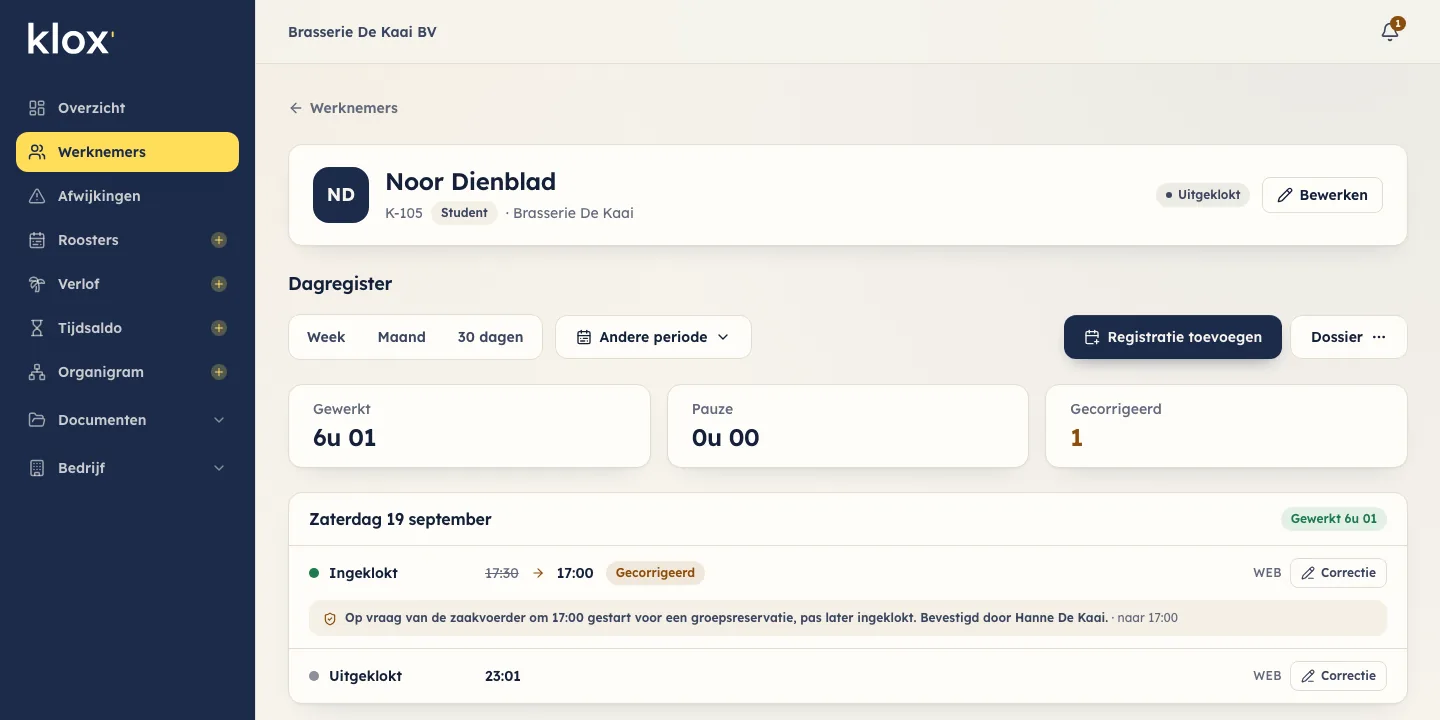
Noor, the brasserie's student worker, starts on Saturday 19/09 at 17:00 but only clocks in at 17:30. The owner corrects the clock-in to 17:00, with the reason: she started earlier at the owner's request for a group booking. A same-day correction like this goes through the correction window.
GKS and ASA: the hospitality reduction has been abolished
The registered cash system (GKS/SCE, the "white till") is a tax obligation for businesses with more than EUR 25,000 in annual turnover from restaurant and catering services, excluding VAT and drinks.[3] It is not a time-registration obligation in itself.
What the rule says
What Klox does
Part-time employees
If a part-time employee deviates from their schedule, you record it: in a deviation document with name, date and the start and end time of the work done outside or differing from the schedule, or with a time-tracking system that records start, end and rest breaks per day at the moment they begin or end.[5] You keep that data for five years.[5] With a time-tracking system, the union delegation must be able to exercise its powers.[5]
And the announced general obligation?
The government announced that it wants to comply with the European Working Time Directive by 1/1/2027 at the latest.[8] In the Chamber committee, the Minister of Employment said the obligation to register working time will also apply to flexi-jobs.[7] On 22/09/2026 no law has been voted and nothing has been published in the Belgian Official Gazette: start date, technical requirements and exceptions are not yet fixed.
See the current statusWhat Klox does, and what it doesn't
- Your team clocks in via the browser on a phone, tablet or the till PC, with nothing to install. If the wifi drops, the clock action is kept and marked separately as offline.
- Every interruption is a separate clock-in and clock-out; the daily register totals the time worked per day.
- A raw clock action is never overwritten. A correction is added as a separate line, with reason, author and timestamp.
- A forgotten clock-out is closed after 12 hours (configurable) with a marked entry and appears in the deviations.
- Klox keeps registrations for five years by default and exports them per employee and period as PDF or CSV.
What Klox is not
- Not a registered cash system: Klox does not replace your certified till.
- No Dimona or ASA link: you file your declarations as you do today.
- No iOS or Android app yet: it is in development. Clocking in works in the browser, or from 1/11/2026 on the Klox Kiosk.
- Whether Klox can count as a time-tracking system in your situation is best confirmed with your payroll provider.
Sources
- [1]NSSO (RSZ): Flexi-jobs (Dutch) (accessed on 22/09/2026)
- [2]NSSO (RSZ): Administrative instructions 2026/3, target-group reduction for permanent hospitality employees (Dutch) (accessed on 22/09/2026)
- [3]FPS Finance: Registered cash system, who and when (Dutch) (accessed on 22/09/2026)
- [4]NSSO (RSZ): Administrative instructions 2026/3, Dimona for students (Dutch) (accessed on 22/09/2026)
- [5]FPS Employment, Labour and Social Dialogue: Monitoring the work of part-time employees (Dutch) (accessed on 22/09/2026)
- [6]Belgian Chamber of Representatives: File 56K1526, bill on flexi-jobs (Dutch) (accessed on 22/09/2026)
- [7]Belgian Chamber of Representatives: DOC 56 1526/003, report of 03/06/2026, p. 93 (Dutch and French) (accessed on 22/09/2026)
- [8]Belgian Chamber of Representatives: DOC 56 1353/001, motion for a resolution on working-time registration, p. 6 (Dutch and French) (accessed on 22/09/2026)
Curious how this works for your business?
Try Klox free for fourteen days with your own team, with flexi-jobbers, students or split shifts, no payment details needed. Your account is ready in a few minutes.