Time registration in a shop
For your part-time staff, some rules already apply today: a variable schedule must be announced in advance, and every deviation from the schedule is recorded, on paper or with a time-tracking system. A general obligation for all employees has been announced, but on 22/09/2026 it has not been voted or published. Below: a shop week with a lunch break, a swapped shift and a Saturday.
Written by Robin Verbelen, founder of Klox
Updated on 22/09/2026Last checked on 22/09/2026
A shop week, registered
Buurtwinkel 't Mandje in Antwerp is a fictitious shop with four people. Two full-time sales assistants alternate an early and a late shift, with a lunch break. A part-time colleague works on Saturday mornings. On Thursday 17/09/2026, Sara and Bert swap shifts.
| Day | Employee | Schedule | Registered | Worked |
|---|---|---|---|---|
| Thu 17/09 | Bert (full-time) | 10:00-18:15, swapped to 08:45-17:00 | 08:44-16:59, break 12:34-13:16 | 7h33 |
| Thu 17/09 | Sara (full-time) | 08:45-17:00, swapped to 10:00-18:15 | 10:01-18:14, break 13:30-14:12 | 7h31 |
| Fri 18/09 | Bert (full-time) | 10:00-18:15 | 09:58-18:18, break 13:34-14:16 | 7h38 |
| Sat 19/09 | Ines (part-time) | 09:00-13:30 | 08:58-14:31 | 5h33 |
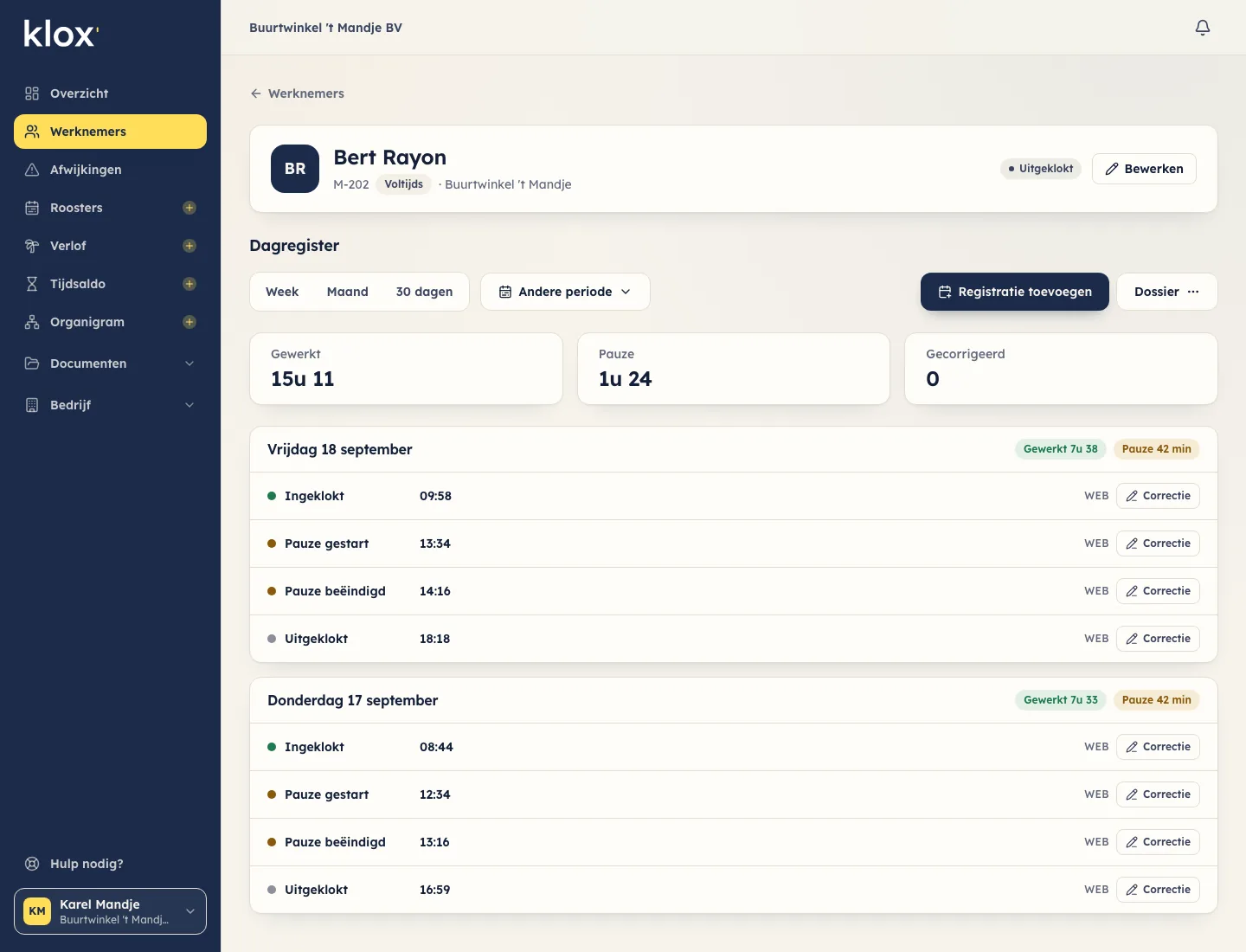
With the swap, nobody has to rewrite anything: every clock action is in the name of whoever was actually in the shop. On Saturday Ines stayed an hour longer because it was busy. For a part-time employee that is a deviation from the schedule, and it has to be recorded.
Announcing a part-timer's schedule in advance
What the rule says
What Klox does
Recording a deviation from the schedule
Ines was scheduled from 09:00 to 13:30 and worked until 14:31. You must be able to show that extra time.
What the rule says
What Klox does
Failing to announce schedules correctly or to record deviations risks a level 3 sanction; failing to keep those documents or keep them accessible risks a level 2 sanction (Social Criminal Code, art. 151 and 152).[3]
And your full-time sales staff?
For employees on a fixed full-time schedule there is no general registration obligation today.[5] With flexible (sliding) working hours there is: you then provide a time-tracking system showing the duration of work per employee per day, accessible to the employee and to the inspectorate, and you keep that data for five years after the day it relates to.[4]
And the announced general obligation?
In 2019 the Court of Justice of the EU ruled that Member States must require employers to record the daily working time of every employee.[6] The government announced that it wants to comply with this by 1/1/2027 at the latest.[5] On 22/09/2026 no law has been voted and nothing has been published in the Belgian Official Gazette: start date, technical requirements and exceptions are not yet fixed.
See the current statusWhat Klox does, and what it doesn't
- Your staff clock in via the browser on a phone, tablet or the PC behind the counter, with nothing to install.
- A shift swap needs no adjustment: every clock action is in the name of whoever actually worked.
- The start and end of the lunch break are recorded separately if you have breaks registered.
- A raw clock action is never overwritten. A correction is added as a separate line, with reason, author and timestamp.
- Several locations under one organisation, each with its own employees.
- Klox keeps registrations for five years by default and exports them per employee and period as PDF or CSV.
What Klox is not
- Not a till system and not staff planning based on sales forecasts.
- No Dimona link: you file your declarations as you do today.
- No iOS or Android app yet: it is in development. Clocking in works in the browser, or from 1/11/2026 on the Klox Kiosk.
- Whether Klox can count as a time-tracking system in your situation is best confirmed with your payroll provider.
Sources
- [1]FPS Employment, Labour and Social Dialogue: Monitoring the work of part-time employees (Dutch) (accessed on 22/09/2026)
- [2]Justel: Act of 08/04/1965 on work regulations, art. 6 (Dutch) (accessed on 22/09/2026)
- [3]Justel: Social Criminal Code, art. 151 and 152 (Dutch) (accessed on 22/09/2026)
- [4]Justel: Labour Act of 16/03/1971, art. 20ter (Dutch) (accessed on 22/09/2026)
- [5]Belgian Chamber of Representatives: DOC 56 1353/001, motion for a resolution on working-time registration, p. 6 (Dutch and French) (accessed on 22/09/2026)
- [6]Court of Justice of the EU: Judgment of 14/05/2019, C-55/18 (CCOO), paragraph 60 (accessed on 22/09/2026)
Curious how this works for your shop?
Try Klox free for fourteen days with your own team, with part-timers, swaps or several locations, no payment details needed. Your account is ready in a few minutes.