Planned versus worked
Monitoring part-time work is about the difference between two things: the schedule fixed in advance, and what the employee actually works. The rules are in the Programme Act of 22/12/1989 (articles 157 to 171) and the Royal Decree of 08/03/1990.[1]
You keep a copy of the part-time employee's employment contract, or an extract with the work schedules, their identity and the signatures of employee and employer, at the place where the work regulations (arbeidsreglement) can be consulted.[1]
If someone works exactly to that schedule, there is nothing extra to record. The register is about the deviations: work that starts later or ends earlier than the schedule, or work outside the schedule.[1]
Making work schedules known
With a fixed schedule, the schedule is in the contract or the extract you keep (see above).
With a variable schedule, the employee must know in advance on which days and at which hours they work:
- The individual work schedule is communicated at least seven working days in advance, in a reliable, appropriate and accessible way. A collective labour agreement (CAO/CCT) declared generally binding can shorten that to at least three working days.[2]
- The schedule is made known in writing and dated. The notice is available on paper or electronically at the place where the work regulations can be consulted, and you then keep it for a year.[1]
Not making schedules known correctly or not recording deviations risks a level 3 sanction; not keeping the documents or not keeping them accessible, a level 2 sanction (Social Criminal Code, articles 151 and 152).[3]
Recording deviations: two ways
1. The deviation document. The document follows the model laid down by the Royal Decree of 08/03/1990. For each deviation you record the employee's name and the date, and:[1]
- if the employee starts later or stops earlier than the set time: the start and end time, filled in at the start (if they start later) or at the end (if they stop earlier);
- if they work outside the schedule: the start, the end and the rest breaks, each filled in at the moment itself.
2. A time-tracking system. This replaces the deviation document if it:[1]
- states for each employee their identity and the period the data relate to;
- records for each day the start and end of work and of rest breaks, at the moment they start or end;
- keeps the data for five years, on paper or electronically;
- is available for consultation by the employees concerned and the social inspectorate;
- lets the union delegation exercise its powers, in line with CAO/CCT no. 5.
A time-tracking system therefore records all work, not just the deviations. You keep the deviation document from the last mandatory entry until five years after the end of the month following the quarter in which the entry was made.[1]
Quick check for your own situation
What you need in practice depends on the kind of schedule and on how you record deviations. The check below lists the rules from this article for your answers, with the same sources.
Quick check: what do you need today?
Answer a few questions about one part-time employee, or about a group on the same kind of schedule. Your answers stay in your browser: nothing is stored or sent.
What you need under the current rules
Answer the questions above for a complete result. This is what you need in any case:
The contract, or an extract with the work schedules
A copy of the employment contract, or an extract with the work schedules, the employee's identity and the signatures of employee and employer. On paper or electronically, kept at the place where the work regulations can be consulted. This applies to every kind of schedule.[1]
A tool that goes with this article, not legal advice. Your joint committee or a collective labour agreement may have extra rules. The announced general registration obligation (a preliminary draft, not yet voted) plays no part in this check.
Example: a part-time shop assistant with three deviations
Ines Etiket (fictitious) works 19 hours a week at Buurtwinkel 't Mandje BV in Antwerp, on a fixed schedule from her contract: Tuesday 08:30 to 13:00, Wednesday and Friday 13:00 to 18:00, Saturday 09:00 to 13:30. In the week of 14/09/2026 she fills in for a sick colleague on Thursday, stops early on Friday for a doctor's appointment, and stays longer on Saturday because it is busy.
| Date | Schedule | Registered | Break | Worked | Deviation |
|---|---|---|---|---|---|
| 15/09/2026 | 08:30 to 13:00 | 08:28 to 13:01 | none | 4h 33 | no |
| 16/09/2026 | 13:00 to 18:00 | 12:59 to 18:01 | none | 5h 02 | no |
| 17/09/2026 | none | 09:00 to 12:00 | none | 3h 00 | yes, outside schedule |
| 18/09/2026 | 13:00 to 18:00 | 12:58 to 16:30 | none | 3h 32 | yes, ends before schedule |
| 19/09/2026 | 09:00 to 13:30 | 08:58 to 14:31 | none | 5h 33 | yes, ends after schedule |
| Week | 19h 00 | 21h 40 | +2h 40 |
With a deviation document, you record three deviations here, each at the moment itself:[1]
- 17/09/2026, work outside the schedule: the start (09:00) when she begins, the end (12:00) when she stops, and the rest breaks if there are any;
- 18/09/2026, ending before the set time: start and end time (12:58 and 16:30), recorded at the moment she stops;
- 19/09/2026, work outside the schedule after the set end of 13:30: the start (13:30) and the end (14:31), each at the moment itself.
With a time-tracking system, every row of the table is already in it, with start, end and breaks as they happened. Whether a difference of a few minutes, as on Tuesday or Wednesday, already counts as a deviation is not stated explicitly on the FPS page. With a time-tracking system you do not have to answer that question: all times are in it.
How you pay or recover the difference of 2h 40 depends on your joint committee and the arrangements in the contract. That is outside the scope of this article.
What Klox does here
What the rule says
What Klox does
Whether your way of working with Klox counts as an approved time-tracking system also depends on how you use it: do your part-time employees really clock at the start and end of every period of work and every break, and can the union delegation play its role? That remains your responsibility as the employer.
With a schedule per employee (in the Compliance Plus plan), Klox compares the time worked each day with the schedule. In the example, Thursday, Friday and Saturday appear in the list of deviations automatically, because they differ by more than the set margin (15 minutes by default). Klox compares the duration worked, not the hours: a shift that lasts just as long but falls at different hours does not appear in that list, although the actual times are in the register.
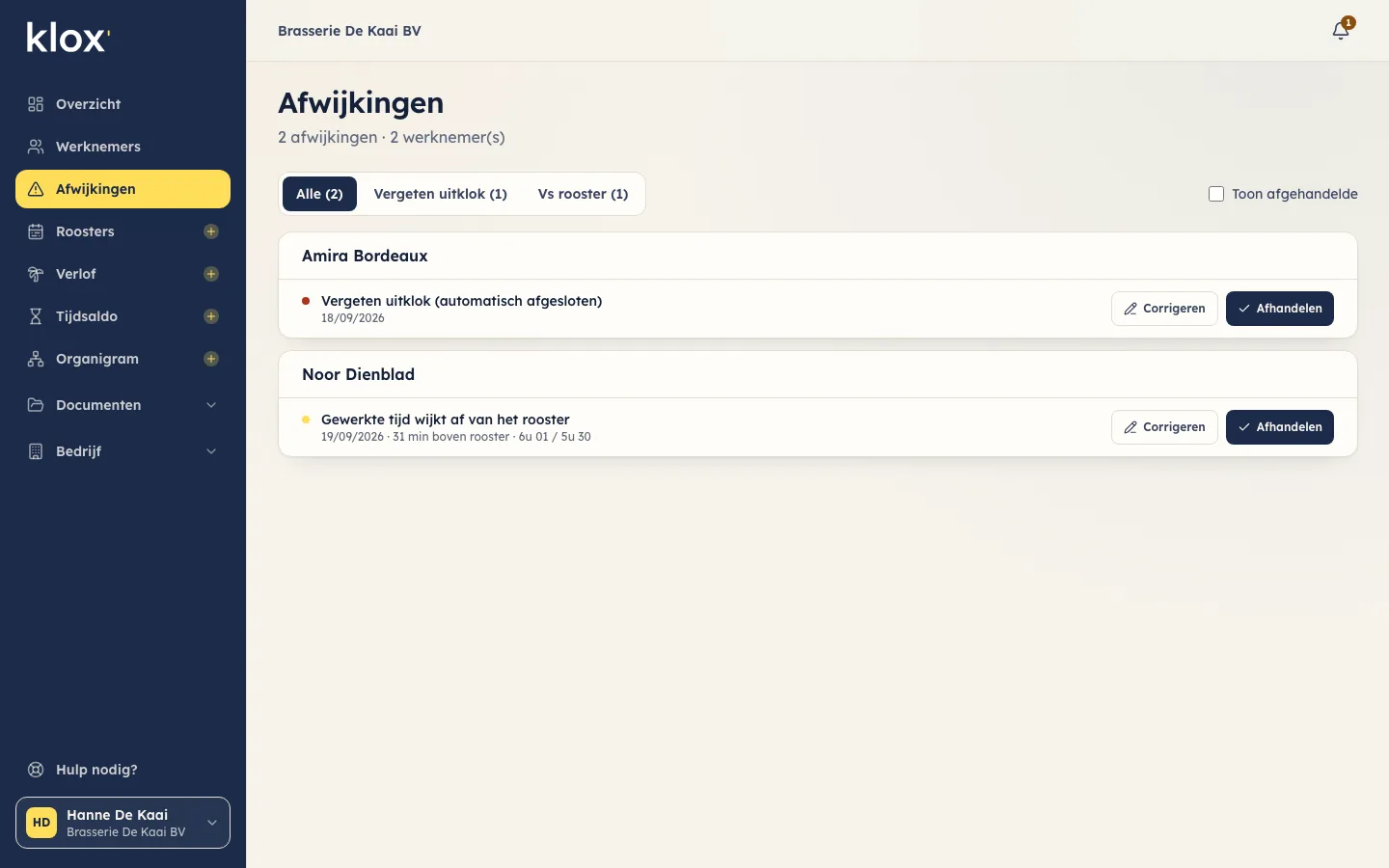
Which features are in which plan is on the pricing page.
And the announced general obligation?
The rules for part-time employees already apply today. The general registration obligation announced for 2027 is not yet laid down in a published legal text: the start date, technical requirements, exceptions and the relationship with existing schemes such as this one are still open. If you also work with flexible working hours (glijdende uurroosters), then for a part-time employee with a fixed schedule in that system, the start, end and rest breaks must also be recorded.[4]
The current state of play, with all sources, is on time registration mandatory in 2027?
Sources
- [1]Monitoring the work of part-time employees (in Dutch), FPS Employment, Labour and Social Dialogue, accessed on 17/10/2026
- [2]Act of 8 April 1965 establishing work regulations, article 6, §1, 1°, d) (in Dutch), Justel, Belgian Official Gazette, accessed on 22/09/2026
- [3]Social Criminal Code, articles 151 and 152 (in Dutch), Justel, Belgian Official Gazette, accessed on 22/09/2026
- [4]Labour Act of 16 March 1971, article 20ter, §5 (in Dutch), Justel, Belgian Official Gazette, accessed on 22/09/2026
Further reading
- Time registration mandatory in 2027?The state of the announced general obligation, with primary sources.
- Time registration with flexible working hoursThe other regime that already requires registration today.
- Deviation register for part-time workersWhat goes in it, when to fill it in and whether it can be digital.
- The inspection fileWhat you show when the inspectorate wants to see the registrations.
- Time registration in retailPart-time teams and shift swaps in retail.
See how Klox handles this for your team?
Try it free for fourteen days with your own team, no payment details needed. Your account is ready in a few minutes.