Do you need to update your work regulations?
The work regulations must state, among other things, your working schedules (or, since 01/06/2026, a framework for normal working hours), and the methods used to measure and monitor work for the purpose of determining pay.[1] If you now record the start and end of every working day in a system, that last point no longer describes what actually happens in your business. That is the reason to update the regulations.
No published rule currently requires a separate "time registration clause". The government announced that it wants to comply with the European Working Time Directive and the case law of the Court of Justice by 1/1/2027 at the latest, but that is an announcement, not a law.[5] Whether the new rules will require a mention in the work regulations is still open. We track the current state of play on the page about time registration and the 2027 law.
Two situations already call for more than one sentence in your regulations today:
- Flexible working hours (glijdende uurroosters). You introduce these through a collective labour agreement (CAO/CCT) or the work regulations.[6] The regulations then state, among other things, the start and end of core time and flexible time, rest breaks, the maximum daily and weekly working hours and the rules for making up hours, with an annex that sets out all the rules of the flexible schedule.[1]
- Part-time workers with a variable schedule. The regulations state the time window and the days within which they can work, the minimum and maximum daily working hours, and how and when you communicate their schedule: at least seven working days in advance, or at least three working days if a generally binding collective labour agreement allows it.[1]
With or without a works council
Which procedure you follow depends on one question: do you have a works council (ondernemingsraad)? A works council is mandatory in companies that normally employ an average of at least 100 employees.[4] An SME with 1 to 20 employees normally does not have one.
- With a works council, the council draws up the regulations and makes the amendments.[1]
- Without a works council, the employer draws up the draft and presents it to the staff by posting it. Employees respond in an observations register, themselves or through a staff or union delegation, or directly to the inspector.[1]
If you have a union delegation but no works council, you follow the procedure without a works council; the delegation can then record observations in the register.[1]
The steps without a works council, with an example
The example is fictitious: Buurtwinkel 't Mandje BV, a neighbourhood shop in Antwerp, with managing director Karel Mandje and three employees. Karel wants his team to clock in in the browser from November 2026, and updates the article on measuring and monitoring work for that purpose. He has no works council and no union delegation.
1. Until 02/10/2026: drafting
Karel writes the new text of the article. He starts from a draft made with the work regulations generator and has it checked by his social secretariat (see below: draft text or reviewed text).2. 05/10/2026: posting the draft and opening the register
The draft is posted where everyone can see it. Every employee can get a copy. From that day, a register is available for 15 days in which employees record their observations.[1] A template is in the guide to the observations register, listed under “Further reading” below.3. 05/10/2026 to 20/10/2026: the 15-day period
Employees write in the register, or send a signed letter to the social law inspector. The inspector may not disclose their name.[1]4. 20/10/2026: taking effect if there are no observations
If the register is empty and the inspector received no letter, the amendment takes effect on the fifteenth day after posting.[1] If there are observations, a conciliation follows; see the timeline below.5. 21/10/2026: the register goes to the inspector
As soon as the period has ended, the employer sends the register to the inspector for review, even if it is empty.[1]6. Dating, signing and the consultation statement
The employer dates and signs the amendment. It also includes the statement that the employees were properly consulted.[1]7. By 28/10/2026 at the latest: a copy to the inspectorate
8. Informing the staff
A notice states where the regulations can be found. Every employee can consult them at any time without an intermediary and receives a copy; a student worker signs a receipt for it. A copy is kept at every place where you employ staff.[1]
Timeline with and without observations
The same fictitious example, in two versions. In the second, an employee records an observation. The inspector passes it on to the employer within four days, the employer posts it, and the inspector tries to reach a conciliation within thirty days. If that succeeds, the amendment takes effect on the eighth day after the conciliation. If it fails, the dispute goes to the joint committee (paritair comité).[1]
| Step | No observations | One observation, conciliation succeeds |
|---|---|---|
| Draft posted, register open | 05/10/2026 | 05/10/2026 |
| End of the 15-day period | 20/10/2026 | 20/10/2026 |
| Register sent to the inspector for review | 21/10/2026 | 21/10/2026 |
| Inspector passes on the observation | not applicable | 23/10/2026 |
| Employer posts the observation | not applicable | 26/10/2026 |
| Conciliation by the inspector | not applicable | 12/11/2026 |
| Amendment takes effect | 20/10/2026 | 20/11/2026 |
| Copy to the inspectorate, at the latest | 28/10/2026 | 28/11/2026 |
Between posting and taking effect, the example has 15 days without observations, and six to seven weeks with a conciliation. If the conciliation takes the full thirty days, or if the joint committee has to decide, it takes longer. In the second version, Karel postpones the start of registration until after 20/11/2026. That is his choice, to keep the regulations and practice in step, not a legal rule.
If you do have a works council
The draft goes to every member of the council and is posted at the same time. The council discusses it no earlier than 15 and no later than 30 days after posting. If there is no agreement, the chair refers the dispute to the inspector within 15 days, who tries to reach a conciliation within 30 days. If that fails, the joint committee decides.[1] The regulations take effect 15 days after the agreement or decision, unless another date has been set, and bear, in addition to the employer's signature, that of at least two employee representatives on the council.[1]
A decision of the joint committee generally requires 75% of the votes of each party. Since 01/06/2026, for an extension of the framework for normal working hours, or for a schedule outside that framework, the support of all present representatives of at least one representative employers' organisation and one employees' organisation is enough. This also applies in the procedure without a works council.[1][3]
What the regulations say about schedules and registration
Since 01/06/2026, you can choose between two ways of describing full-time schedules in the regulations.[1][3]
| Method | What the regulations state |
|---|---|
| Each schedule separately | Start and end of the normal working day, the time and length of rest breaks, the days of regular interruption. For shift work, per shift, plus how and when shifts change. |
| Framework for normal working hours (since 01/06/2026) | The days of the week on which work can take place, the daily time window, the minimum and maximum daily working hours, and the normal and maximum weekly working hours. Schedules within that framework do not each need to be in the regulations. |
For the registration itself, the law currently only requires the regulations to state the methods used to measure and monitor work.[1] What exactly you write there is up to you. Points that an employee and an inspector usually want to find, as a suggestion and not as a legal list:
- how registration works (browser, own smartphone, device on site) and what an employee records: start, end, breaks;
- what happens when someone forgets to clock in or out, and how a correction works;
- who can view the registrations, and how employees consult their own hours;
- how long the data is kept.
If you also use an access badge to record arrival and departure, you must inform your employees about it.[7]
Breaks: the legal minimum
If you describe each schedule separately, the regulations also state the time and length of the rest breaks.[1] How long a break must be at least is in the Labour Act: nobody works more than six hours without interruption, and anyone who works more than six hours gets a break. The length and rules of that break are set by a collective labour agreement (CAO/CCT), or by the King for employers outside the scope of the collective agreements act. If there is no collective agreement or royal decree, it is at least a quarter of an hour, at the latest when the work reaches six hours.[8]
For young workers (minors aged 15 or over who are no longer in full-time compulsory education) the rule is stricter: at most four and a half hours in a row, half an hour of rest for more than four and a half hours of work a day, and an hour for more than six hours, of which half an hour in one go.[8]
Break check: is the break long enough?
Enter the start and end of a working day, and how many minutes of break there were. The check applies the legal minimum that applies when there is no collective labour agreement or royal decree. Nothing is stored or sent.
Fill this in to also check how long someone works without a break. With more than one break: add up the minutes and leave this field empty.
Result
Meets the legal minimum.
- Worked, excluding the break
- 8h 00
- Legal minimum break
- 15 min
- Break entered
- 30 min
- More than 6 hours of work requires a break of at least 15 min. With 30 min, that is fine.[8]
A collective labour agreement of your joint committee or your company can set the length and rules of the break differently; that agreement then applies instead of the quarter of an hour. Check your work regulations too. A tool, not legal advice. The announced registration law (a preliminary draft, not yet voted) plays no part in this check.
Draft text from the generator or reviewed text
The Klox work regulations generator produces a draft article on time registration and a notice for your team in a few minutes. That draft is a starting point. It only becomes a text you post after someone who knows your situation has reviewed it.
| Question | Draft from the generator | Reviewed text |
|---|---|---|
| Who writes it | The generator, based on your company name, registration method and start date | You, your social secretariat or a legal adviser |
| Knows your situation | No: not your joint committee, your collective labour agreements or your existing regulations | Yes, if the reviewer knows your regulations and your sector |
| Takes the new law into account | No, it does not exist yet; the text is general and cautious | Only what has been published at that moment |
| Ready to post | No | Yes, after your own check of the procedure |
If you already use Klox, as an administrator you will also find a clause in the app built from your own settings, such as the retention period and whether breaks are recorded separately. That text also states that you should have it legally reviewed before you include it.
What Klox does, and what it does not
What the rule says
What Klox does
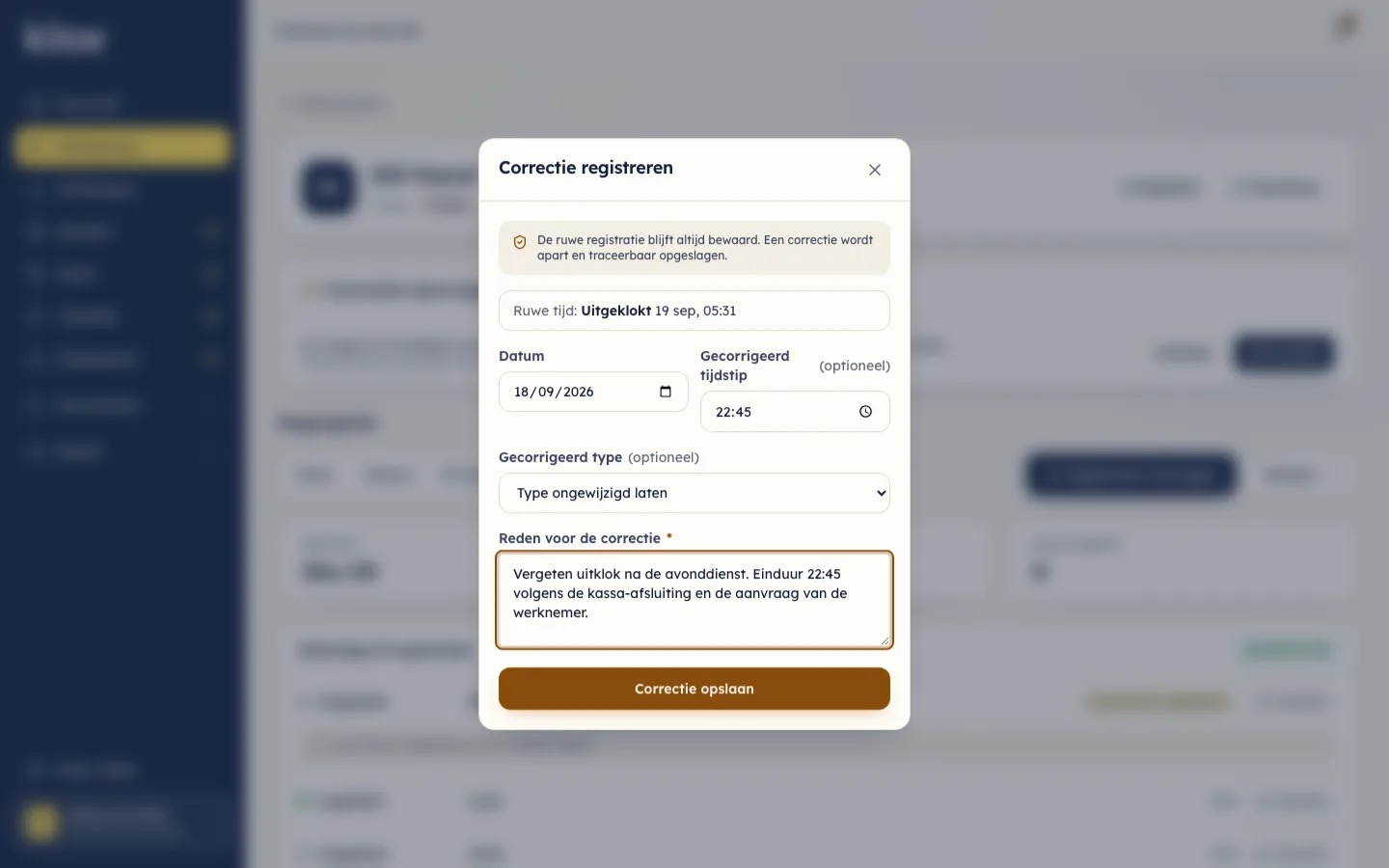
The app is in the App Store and on Google Play; the Klox Kiosk with NFC badge is available to order and ready to ship. So only describe in your regulations the method your employees actually use.
Sources
- [1]Act of 8 April 1965 establishing work regulations (consolidated text, Art. 6, 11 to 15) (in Dutch), Justel, FPS Justice, accessed on 22/09/2026
- [2]Work regulations (Arbeidsreglement) (in Dutch), FPS Employment, Labour and Social Dialogue, accessed on 22/09/2026
- [3]Modernisation of labour law: new measures from 1 June 2026 (in Dutch), FPS Employment, Labour and Social Dialogue, accessed on 22/09/2026
- [4]Works councils (in Dutch), FPS Employment, Labour and Social Dialogue, accessed on 22/09/2026
- [5]Motion for a resolution on working time registration, DOC 56 1353/001 (in Dutch and French), Belgian Chamber of Representatives, accessed on 22/09/2026
- [6]Labour Act of 16 March 1971, Art. 20ter (flexible working hours) (in Dutch), Justel, FPS Justice, accessed on 22/09/2026
- [7]Identification and monitoring of staff (in Dutch), Data Protection Authority (GBA/APD), accessed on 22/09/2026
- [8]Labour Act of 16 March 1971, Art. 2, 3, 3bis, 3ter, 34 and 38quater (breaks) (in Dutch), Justel, FPS Justice, accessed on 17/10/2026
Further reading
See how Klox handles this for your team?
Try it free for fourteen days with your own team, no payment details needed. Your account is ready in a few minutes.